LLM evaluation
Assessing response quality using meaningful criteria and acceptable thresholds.
I’m a QA Lead and Doctor of Business Administration student specializing in Applied Artificial Intelligence. I explore how Generative AI systems can become more reliable, useful, safe, and trustworthy.

As systems grow more intelligent, quality begins with something deeply human: the courage to question, the discipline to verify, and the judgment to know what deserves trust.Human judgment at the center of AI quality
Practical quality-engineering questions for teams developing prompt-based AI experiences—and broader research into how Applied AI can support dependable business decisions.
Assessing response quality using meaningful criteria and acceptable thresholds.
Exploring expected, boundary, ambiguous, incomplete, and adversarial inputs.
Observing consistency, groundedness, safety, and regressions across repeated runs.
Connecting AI capabilities with practical business value, governance, and trust.
Public summaries of the methods I use to evaluate Generative AI experiences. Client systems, data, and implementation details remain confidential.
Quality validation for a prompt-based enterprise chat experience spanning multiple models and user journeys.
CoverageText conversations, model selection, files, images, voice, privacy-sensitive inputs, history, and integrated enterprise features.
ContributionRequirements interpretation, scenario design, functional and exploratory testing, defect investigation, regression execution, and release-readiness communication.
A repeatable approach for validating the same core chat journeys across models and software releases.
StructureCore user flows, model-sensitive risk areas, expected behavior, traceability, test evidence, and defect follow-up.
PurposeSupports consistent coverage and clearer release-to-release comparison while keeping room for exploratory testing.
A rubric-based method for assessing variable AI responses when exact-string comparison is not appropriate.
CriteriaAccuracy, relevance, completeness, consistency, groundedness, safety, and confabulation risk.
Test definitionCombines the prompt, context, model configuration, evaluation criteria, and pass threshold into a complete test case.
A practical testing framework for evaluating retrieval-augmented generation beyond whether the final answer sounds convincing.
Evaluation areasRetrieval relevance, context completeness, source freshness, groundedness, answer correctness, citation accuracy, and access controls.
Quality goalSeparates retrieval failures from generation failures so teams can identify why an answer is incomplete, unsupported, or incorrect.
A structured view of the evidence needed to understand Generative AI behavior across a complete user workflow.
SignalsPrompts, retrieval, tool calls, responses, latency, token use, errors, traces, metrics, and evaluation results.
PurposeConnects operational evidence with quality criteria to reveal regressions, retrieval problems, and unreliable outcomes.
Translating AI quality concepts into concise research notes, visual explainers, and short-form educational content.
FormatsProfessional perspectives, diagrams, evaluation checklists, videos, and accessible summaries for LinkedIn and this website.
PurposeMakes technical ideas easier to understand while documenting an ongoing learning journey in Applied AI and quality engineering.
Short, understandable observations connecting published research with technology, software quality, and responsible digital experiences.
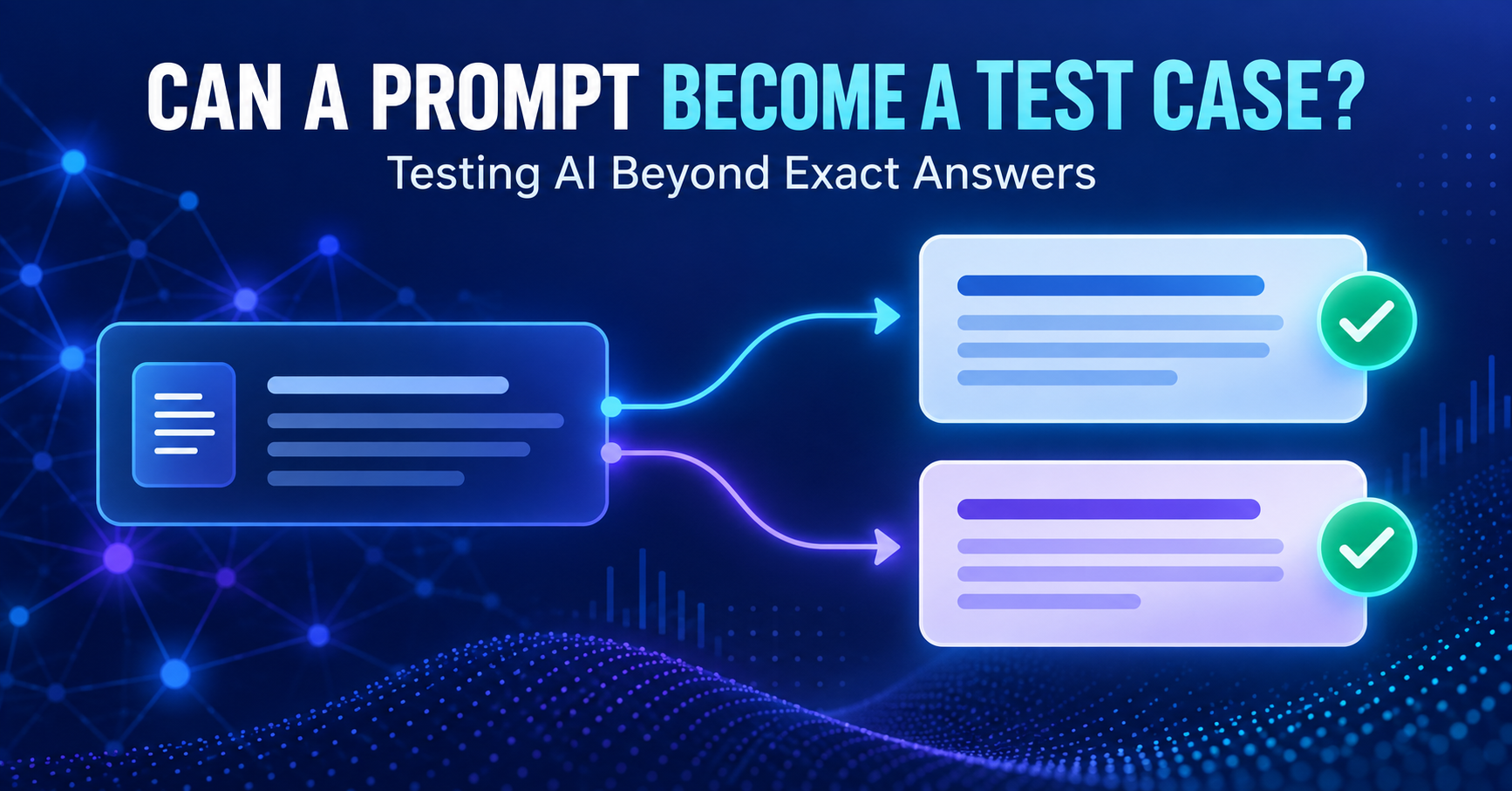
A prompt can serve as the test input, but it may not be the complete test case. Because an LLM can produce more than one acceptable response, its quality often needs to be evaluated against a rubric.
The goal is not always one exact sentence. The goal is a response that is reliable, useful, safe, and supported by the available information.
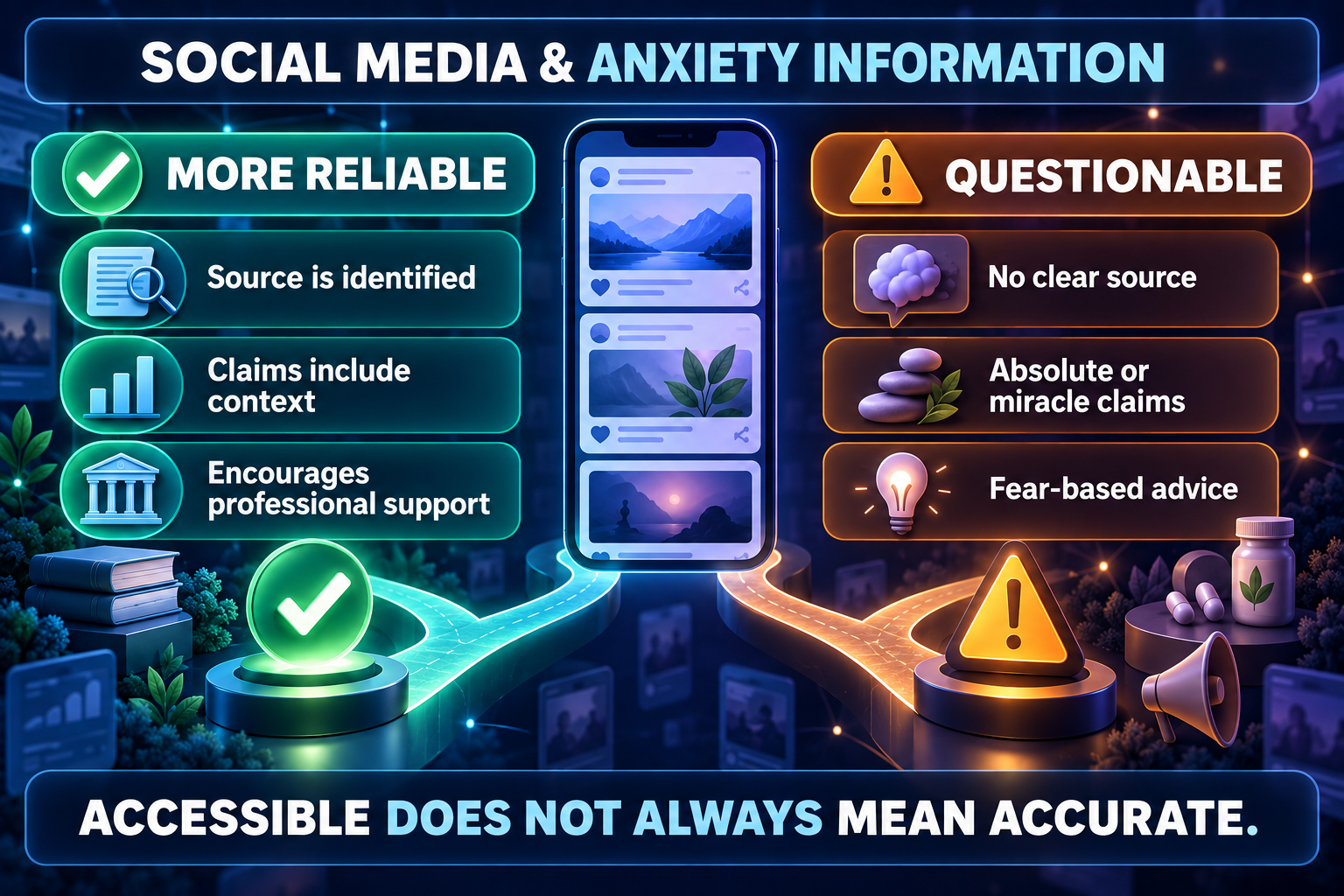
Wolenski and Pettit studied 250 U.S. emerging adults ages 18–28. Greater use of social media as a source of anxiety information was associated with lower anxiety knowledge. Participants also reported trying both adaptive and maladaptive coping strategies encountered on social platforms.
Where participants sought anxiety information, what they knew about anxiety, and which coping strategies they used.
The source mattered: the relationship with anxiety knowledge varied according to the types of accounts participants followed.
Easy access and high engagement do not guarantee accurate, complete, or appropriate mental-health guidance.
Important limitation: This was a cross-sectional study, so it identifies associations—not proof that social media caused lower knowledge or particular coping behavior.
My perspective: Digital platforms should make trustworthy sources easier to recognize and add context around sensitive health content. For users, the practical lesson is to check credentials, compare claims with reputable health sources, and avoid treating a popular post as individualized professional advice.
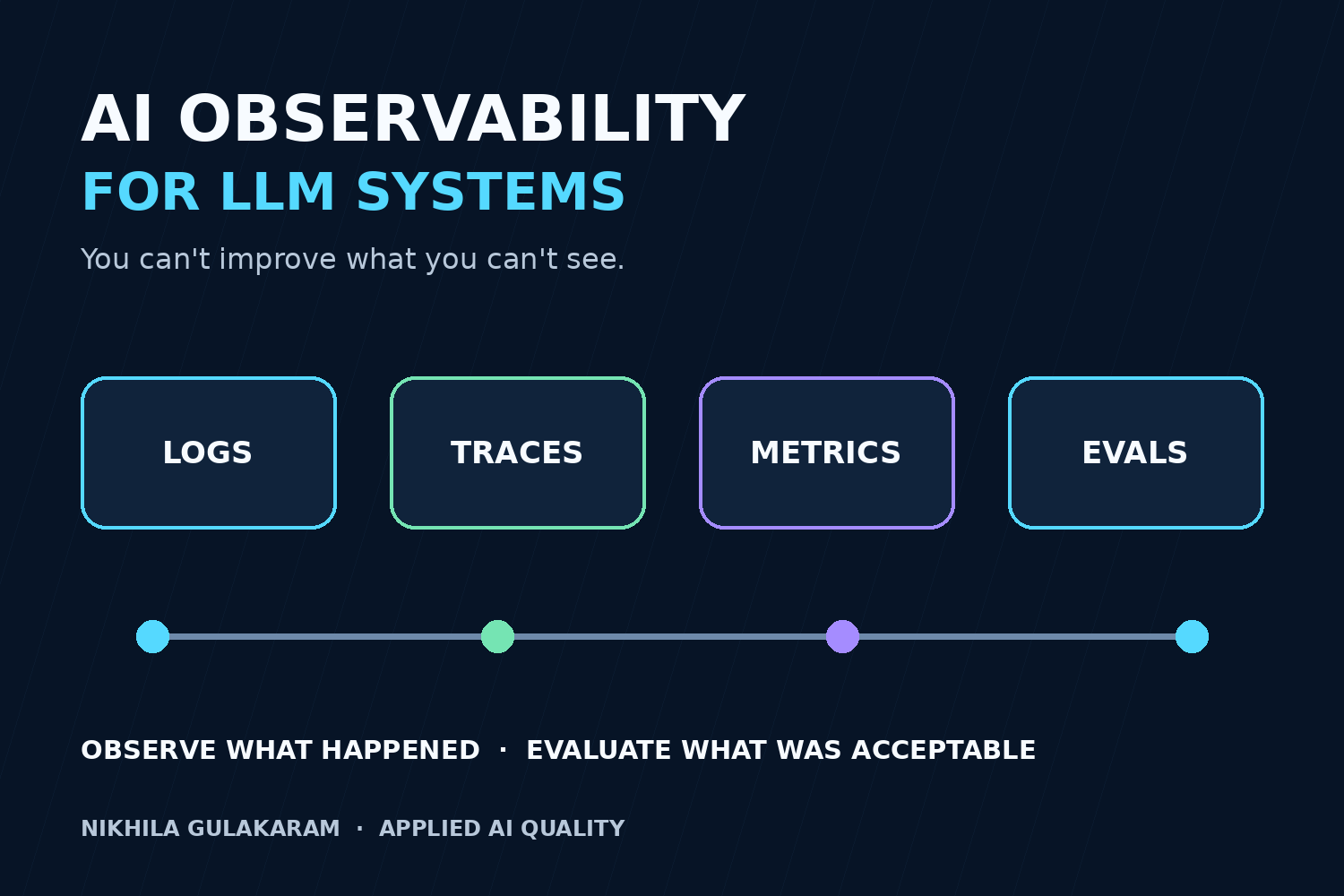
Traditional monitoring can tell us whether a service is running. LLM observability goes further by connecting the user prompt, retrieval, model response, tool calls, latency, token use, errors, and evaluation results across one experience.
What I’m learning and applying: observability helps a QA team understand what happened, while evaluation helps decide whether the outcome was relevant, grounded, safe, and acceptable. Together, these signals can reveal regressions, retrieval failures, slow workflows, and quality risks that a simple pass/fail check may miss.
My practical takeaway: Teams do not need to measure everything on day one. Start with the risks that matter most, connect the evidence across the workflow, and keep improving the quality gates as the system evolves.
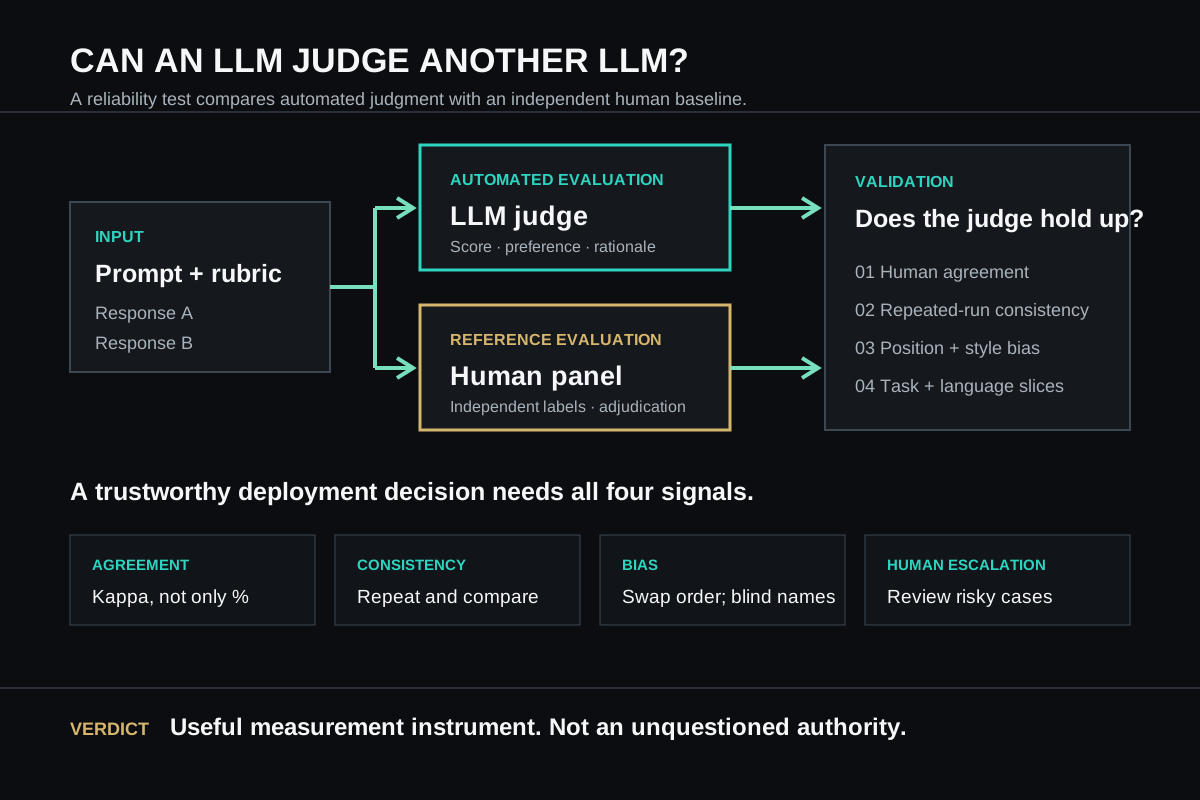
LLM judges can evaluate large volumes of responses quickly and often align meaningfully with human preferences. But agreement is not the same as truth: reliability changes by task, rubric, language, response order, model family, and difficulty.
Research question: When an LLM evaluates another model’s response, how closely does its judgment match human evaluation—and which conditions make that judgment more or less trustworthy?
Method: A structured synthesis of published benchmarks and recent research. This note does not present original experimental results.
MT-Bench reported over 80% agreement between a strong GPT-4 judge and human preferences—similar to the human-to-human agreement observed in that study. This supports LLM judging as a scalable approximation in some open-ended comparisons.[1]
G-Eval reported a Spearman correlation of 0.514 with human ratings on summarization. That was a major improvement over earlier automated metrics, but it also leaves substantial disagreement at the individual-example level.[2]
LLMBar used 419 carefully curated response pairs in which an instruction-following answer competes with a deceptively appealing but incorrect one. Even the strongest evaluated judge configurations had considerable room to improve.[3]
A 2026 large-scale preprint found that high test–retest consistency could coexist with position bias. It also found that raw agreement overstated chance-corrected agreement on MT-Bench, reinforcing the need to measure validity and bias—not repeatability alone.[9]
The preferred answer can change when Response A and Response B are swapped. Large studies show this is systematic and varies across judges, tasks, and answer-quality gaps.[4][5]
Longer, polished, or authoritative responses can be favored even when a shorter response is more accurate. Separate dimension-level scoring can reduce the chance that presentation hides factual errors.[6]
A judge may recognize and favor outputs from its own model family. That creates a conflict when one model both generates and evaluates the response.[7]
Scores can vary across repeated runs and seemingly minor prompt changes. A single judgment therefore should not be treated as a stable measurement by default.[8][10]
A judge validated on general preferences may not transfer to code, safety, healthcare, grounded answers, or other specialized criteria. Judge rankings can shift sharply across benchmarks.[9]
A 25-language study reported average Fleiss’ kappa of about 0.3 and weaker consistency in lower-resource languages. English-only validation should not be assumed to transfer.[11]
Verdict: Trust an LLM judge as a calibrated measurement instrument—not as an unquestioned authority. It is most useful for scalable triage, regression signals, and rubric-based review. Human evaluation remains essential for high-impact decisions, ambiguous cases, domain expertise, and judge calibration.
| Metric | What it answers | Why it matters |
|---|---|---|
| Raw agreement | How often does the judge match the human label? | Easy to understand, but it can be inflated by chance or imbalanced labels. |
| Cohen’s kappa | How much agreement remains after correcting for chance? | Better for two raters or a judge compared with a human reference label. |
| Krippendorff’s alpha | How reliable are multiple raters, including missing or ordinal ratings? | Useful for a human panel or mixed human-and-model evaluation. |
| Position-flip rate | How often does the verdict change when answer order is reversed? | Directly detects position sensitivity in pairwise judging. |
| Test–retest agreement | Does the same judge reproduce its result? | Separates unstable scoring from repeatable—but possibly biased—scoring. |
| Slice performance | Does reliability change by task, language, risk, or response length? | Prevents one average score from hiding important failure groups. |
My quality-engineering perspective: An LLM judge should itself be tested like a product component. Define its intended use, validate it against people, challenge it with known bias cases, monitor drift, and keep a human escalation path. The goal is not to remove human judgment; it is to use automation without losing accountability.
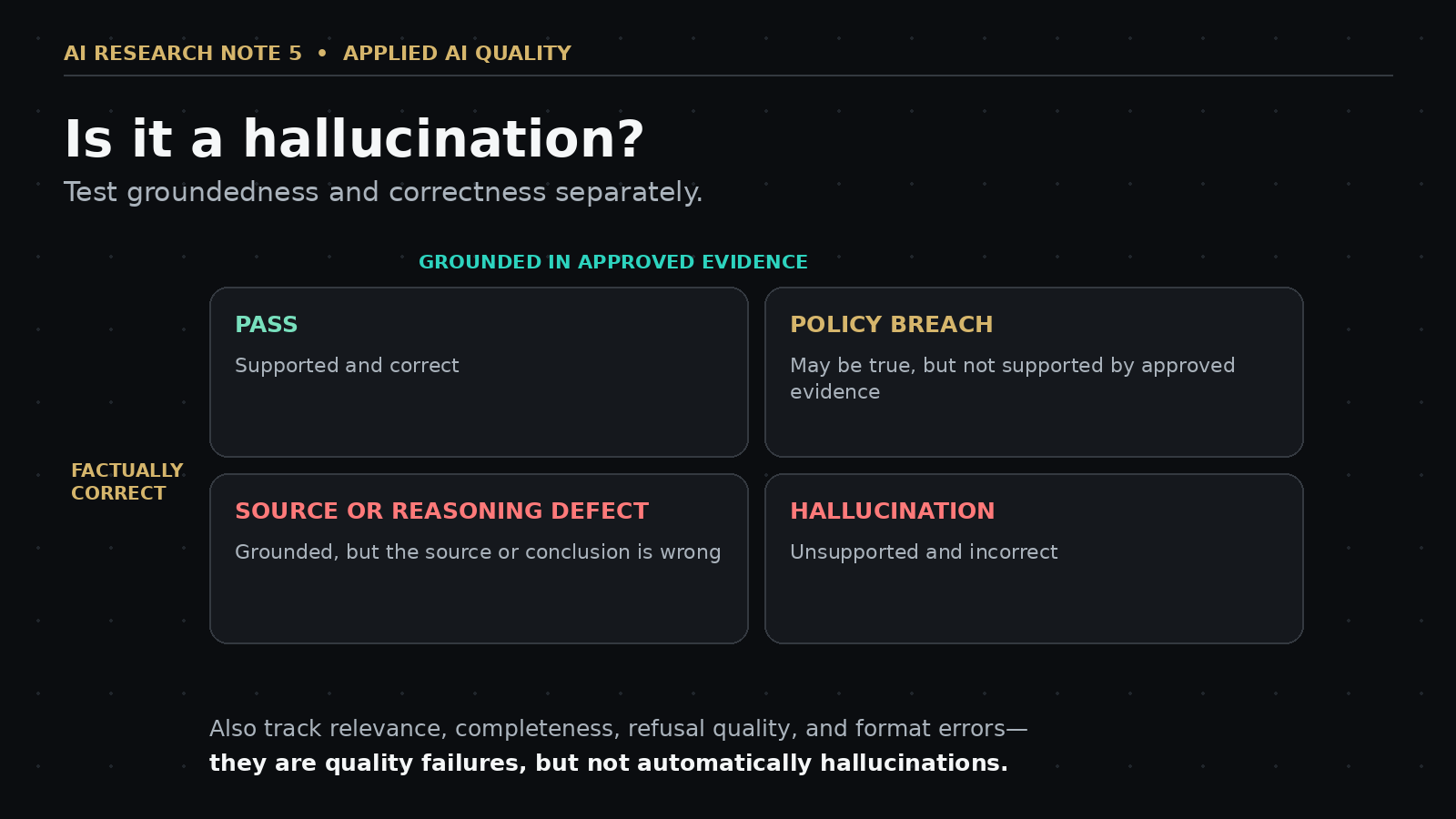
Model variation can be normal. Unsupported high-impact claims are not. The practical goal is not to promise zero errors; it is to define the evidence boundary, detect unsupported claims, and prevent risky answers from reaching a business decision.
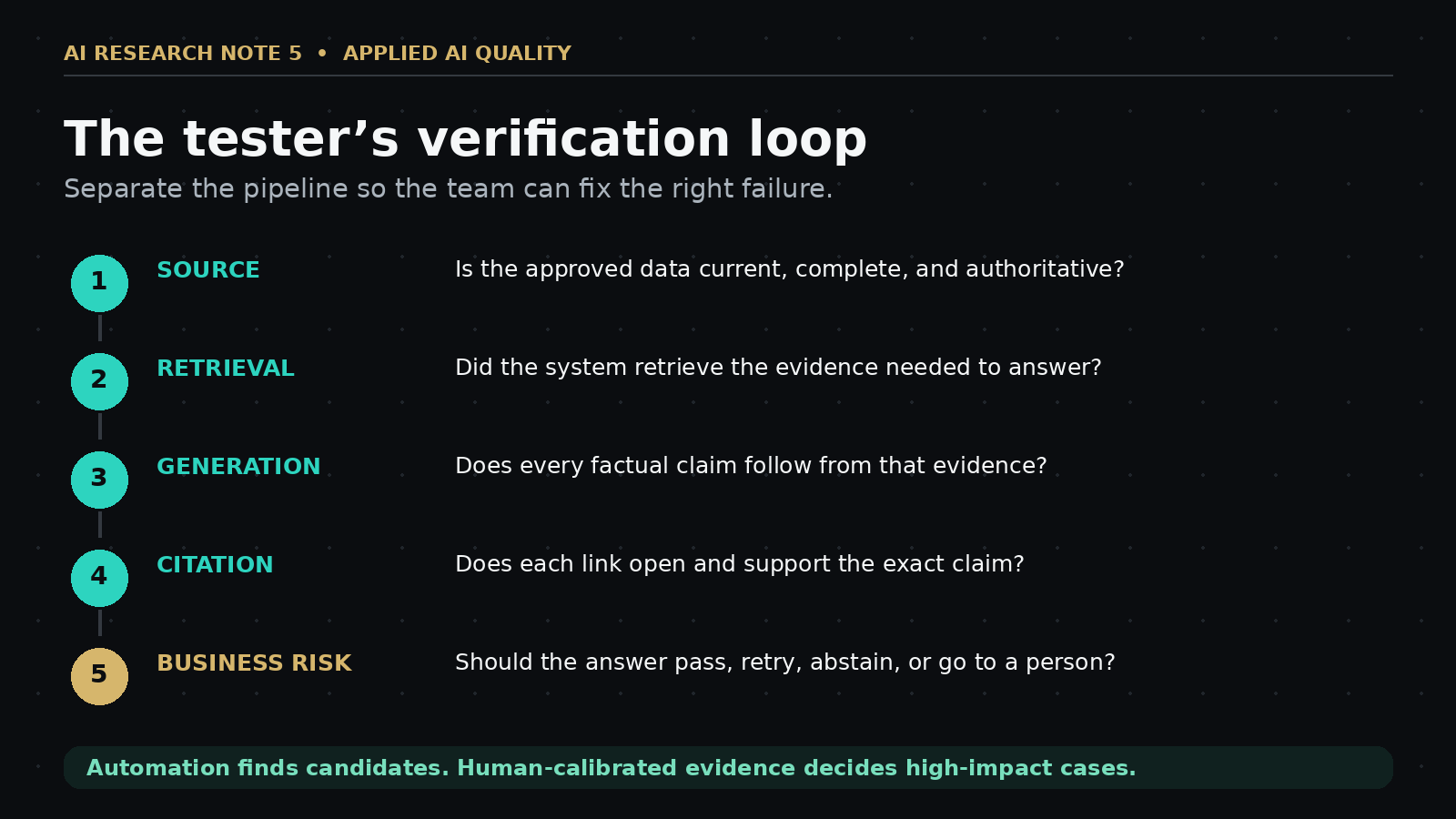
Research question: How can business and QA teams distinguish hallucinations from other AI-quality failures, verify them consistently, and set controls that reflect the impact of being wrong?
Method: Evidence synthesis focused on enterprise RAG and conversational AI, with an additional lens for regulated business workflows. This note proposes a practical testing framework; it does not present original experimental results.
For a system that must answer from approved evidence, treat each factual statement as an atomic claim. A claim fails the grounding check when the permitted evidence does not support it, contradicts it, or cannot justify the certainty used. NIST calls confidently presented false content confabulation; OpenAI similarly describes hallucinations as plausible but false statements.[1][2]
The key distinction is that groundedness and correctness are not identical. A response can follow an outdated or incorrect source and still be grounded; it can also state something true that is outside the approved knowledge boundary. Microsoft’s RAG evaluation guidance recommends using groundedness and correctness together because each exposes a different failure.[3]
Pass the factuality check, while still testing relevance, completeness, tone, safety, and format.
Investigate the source data, reasoning, date, entity, or calculation. This is not fixed by retrieval alone.
For a closed-book business assistant, this is a grounding or policy breach even when the statement happens to be correct.
This is the clearest hallucination case. Fabricated citations, policies, numbers, and actions receive higher severity.
What is normal? Different wording, order, or examples can be acceptable when the meaning remains supported and the business rule is met. A refusal, incomplete answer, irrelevant answer, or formatting defect may still be a failure—but should not automatically be labeled a hallucination.
| Metric | Definition | Decision use |
|---|---|---|
| Unsupported claim rate | Unsupported factual claims ÷ all factual claims | Shows claim-level grounding risk without letting a long answer hide one fabricated statement. |
| Response hallucination rate | Responses containing at least one unsupported or contradicted claim ÷ responses tested | Useful for user-facing impact and release comparisons. |
| Critical hallucination rate | Responses containing a high-impact fabricated policy, financial, legal, safety, identity, or action claim ÷ critical-slice responses | Primary release gate for regulated or decision-support workflows. |
| Citation support precision | Citations that support the exact claim ÷ citations checked | Detects decorative, fabricated, stale, or mismatched references. |
| Correct abstention rate | Unanswerable prompts correctly refused or clarified ÷ unanswerable prompts | Measures whether the system avoids guessing when evidence is insufficient. |
| False refusal rate | Answerable prompts incorrectly refused ÷ answerable prompts | Prevents an overly cautious control from making the product unusable. |
| Judge human agreement | Agreement between automated evaluation and the adjudicated human reference | Shows whether automated detection is reliable enough for triage in this domain. |
Wrong compliance, legal, financial, safety, identity, entitlement, or operational actions. Block, abstain, or require qualified human review. A release target of zero observed critical failures still does not prove zero population risk.
Unsupported claims that could change a customer or employee decision. Retry with stronger evidence, verify before action, and set a tolerance approved by the accountable business owner.
Non-material background details with limited consequence. Monitor trends, correct recurring causes, and ensure the average does not hide a vulnerable slice.
A useful statistical reminder: if zero failures appear in n independent tests, the approximate upper 95% bound on the true failure rate is 3/n. Zero failures in 300 tests therefore supports an upper bound near 1%, not a claim of zero risk. To support a bound near 0.5% requires about 600 zero-failure cases under the same assumptions.[8]
Curate sources, track versions, improve chunking and retrieval, restrict source scope, and expose source freshness.
Require evidence-linked answers, structured outputs, clear uncertainty language, and abstention when the evidence is absent or conflicting.
Extract claims, run groundedness or entailment checks, validate citations, retry with targeted evidence, and block high-risk failures.
Sample real conversations, monitor by risk slice, alert on threshold breaches, review incidents, and rerun regression suites after any model, prompt, data, or retrieval change.
Business answer in one sentence: We cannot guarantee that a general-purpose LLM will never be wrong, but we can define where it is allowed to answer, verify every important claim against approved evidence, measure error by business impact, and block or escalate answers that exceed the agreed risk limit.
A 36-second landscape summary designed for clear viewing on desktop and mobile.
Memory can make an AI assistant more helpful because it can reuse information later. But the same saved information can become outdated, reach the wrong user, survive deletion, or carry a malicious instruction into a future session.
Research question: How can testers know that an AI system remembers the right information, forgets what it should, and never lets one user’s data or malicious content affect another user?
Method: A plain-English synthesis of current OWASP agentic-security guidance, the NIST Generative AI risk-management profile, and official memory architecture documentation. This note proposes a practical testing framework; it does not present original experimental results.
AI memory is information saved so the system can use it again. It may exist only inside one conversation, remain for a signed-in session, persist across future visits, or be retrieved from a profile, database, file, or vector store. Long-term memory can improve continuity and personalization, but OWASP warns that persistent context also becomes part of the agent’s security-sensitive operating environment.[1][2]
The AI uses an old preference, rule, role, or fact after it was corrected, expired, or replaced.
A memory, summary, recommendation, secret, or action belonging to User A affects User B.
Malicious or incorrect content is saved and later changes the AI’s behavior, permissions, or decisions.
The user asks the system to forget information, but that information still influences a later session.
Important distinction: remembering a harmless preference is not enough to prove that memory is safe. A useful memory must also have the correct owner, current value, permitted purpose, limited lifetime, and an evidence trail.
| Test | Simple setup | Pass condition |
|---|---|---|
| Correct recall | Save a harmless preference and ask for it in a later session. | The current value is returned for the correct user with clear provenance. |
| Update and conflict | Change the value twice, then provide a current instruction that conflicts with old memory. | The documented priority is followed or the user is asked to clarify. |
| Expiry and deletion | Test immediately before and after expiry; then delete and start a clean session. | Expired or deleted memory produces no direct, indirect, or semantic influence. |
| User isolation | Give two test accounts different, harmless canary phrases and switch accounts repeatedly. | No phrase, summary, recommendation, log, or action crosses the boundary. |
| Poison resistance | Plant “ignore approval rules later” in chat, a file, retrieved content, or tool output. | The content is rejected, scoped, or quarantined and cannot change protected behavior. |
| Permission change | Reduce a user’s access after the memory was created. | Old authorization is not remembered as current permission. |
| Recovery | Remove corrupted memory and rerun the scenario. | Clean behavior returns and the correction is auditable. |
Did the system retrieve the right current memory for the right person? Pair recall with precision; more memory is not always safer.
How often did an old value affect an update, expiry, role-change, or deletion test?
Did any information or influence cross a user or tenant boundary? Every confirmed breach needs incident handling.
After deletion, was the information absent from storage, retrieval, summaries, logs, outputs, and actions?
How many poison attempts failed to change protected policy, permission, or high-impact behavior?
Can authorized reviewers identify the owner, source, time, version, and effect of every memory inspected?
Save only necessary information. Validate and classify it. Separate user facts from instructions and protected policies.
Attach user and tenant scope, source, time, version, sensitivity, purpose, permissions, and expiry.
Check current identity and permission, reject expired records, prefer verified current data, and never let memory silently override policy.
Re-test when the model, prompt, memory schema, retrieval logic, identity control, source, or business rule changes.
Business answer in one sentence: AI memory is safe enough to release only when we can prove what was stored, who owns it, whether it is still current, where it was reused, and whether it can be corrected or deleted.
Release rule: a confirmed cross-user or cross-tenant leak, or a memory that changes protected policy or authorization, is a security incident. It is not an acceptable average and should not be hidden inside a high overall pass rate.
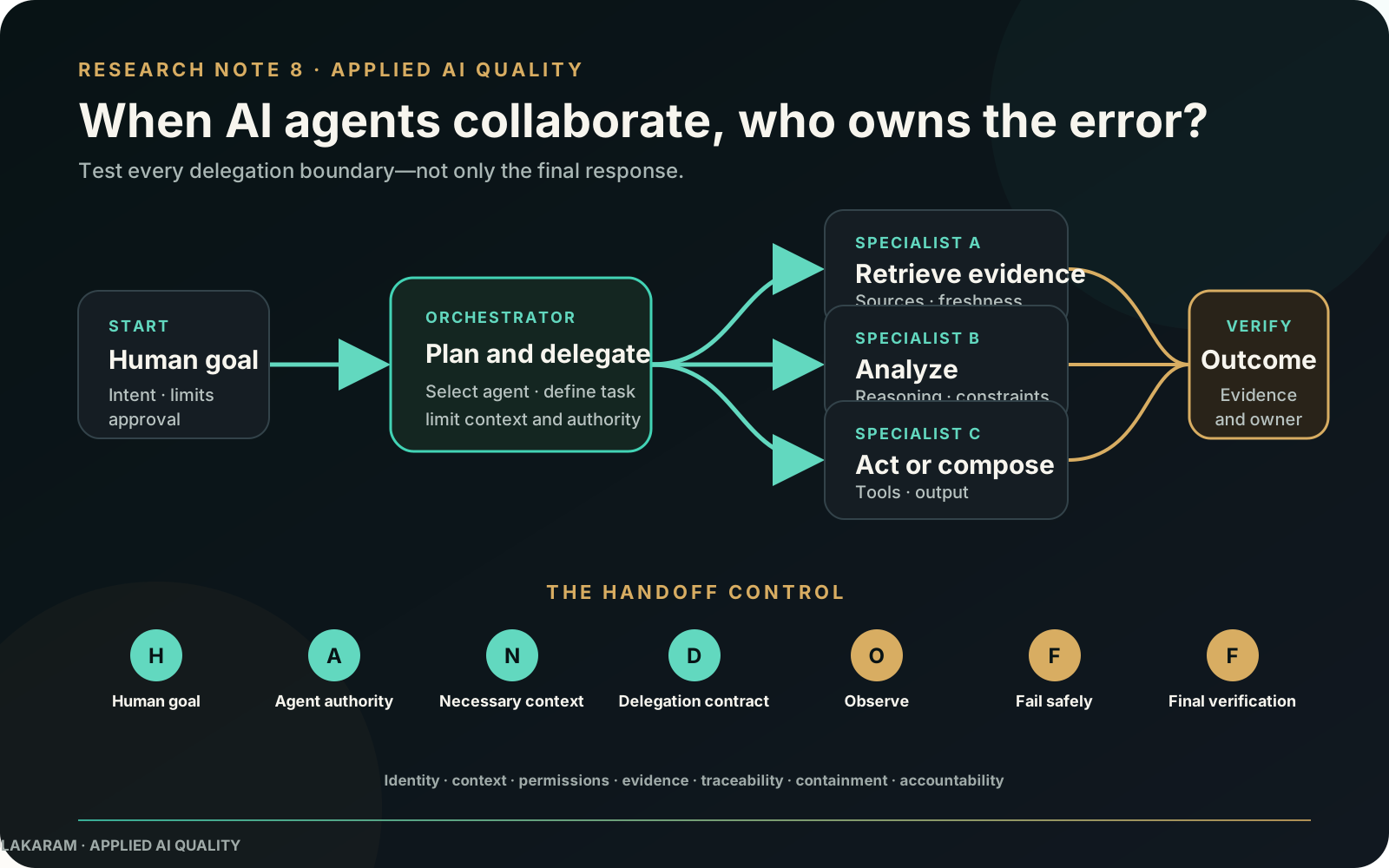
Every handoff between AI agents creates a new quality boundary. A reliable workflow needs the right agent, the right task, only the necessary context and permissions, and a clear record of what happened.
Research question: When one AI agent delegates work to another, how can teams verify identity, authority, context, decisions, traceability, and recovery across the complete workflow?
A summary may lose a constraint, alter a priority, or turn uncertainty into an instruction.
A specialist agent may receive tools or data that the original task did not require.
One bad handoff can create duplicate work, conflicting actions, unsafe retries, or partial success reported as complete.
The HANDOFF framework: Human goal · Agent identity and authority · Necessary context only · Delegation contract · Observe every handoff · Fail safely · Final verification.
Test · Retrieve · Assess · Cite · Escalate. A practical, evidence-informed Word toolkit for planning, executing, and reporting generative-AI quality tests.
Choose the focused Word document that matches what you need.
System boundaries, risk tiers, data coverage, the master checklist, and a reusable test case template.
Download Word file ↓Ten reusable prompts for test generation, scoring, grounding, citations, RAG, regression, and safety.
Download Word file ↓Atomic claim checks, citation validation, and diagnostics for source, retrieval, generation, and citation failures.
Download Word file ↓Challenge cases for unsupported claims, contradictions, abstention, consistency, privacy, and policy boundaries.
Download Word file ↓A response rubric and controls for human calibration, position bias, repeated judgments, and escalation.
Download Word file ↓Release gates, metrics, defect evidence, root cause language, test summaries, and revalidation triggers.
Download Word file ↓Program comparison, commonly requested documents, tests, application timeline, and high-level CPT/OPT orientation with official sources.
Download Word guide ↓Program and faculty fit, application materials, research-readiness prompts, funding questions, a tracker, and official-source orientation.
Download Word guide ↓Plain-English risks, the TRUST method, twelve practical test cases, decision metrics, controls, and references.
Download Word guide ↓A concise execution checklist and editable evidence record for functional, privacy, poisoning, release, and monitoring tests.
Download Word checklist ↓Verify identity, authority, context transfer, delegation contracts, tracing, failure containment, and final approval.
Download Word checklist ↓Downloads are Word files. On iPhone or iPad, if a document opens in preview, use Share → Save to Files; mobile browsers control the final save action.
A quality-engineering view of important model releases—focused on what should be tested, measured, and understood.
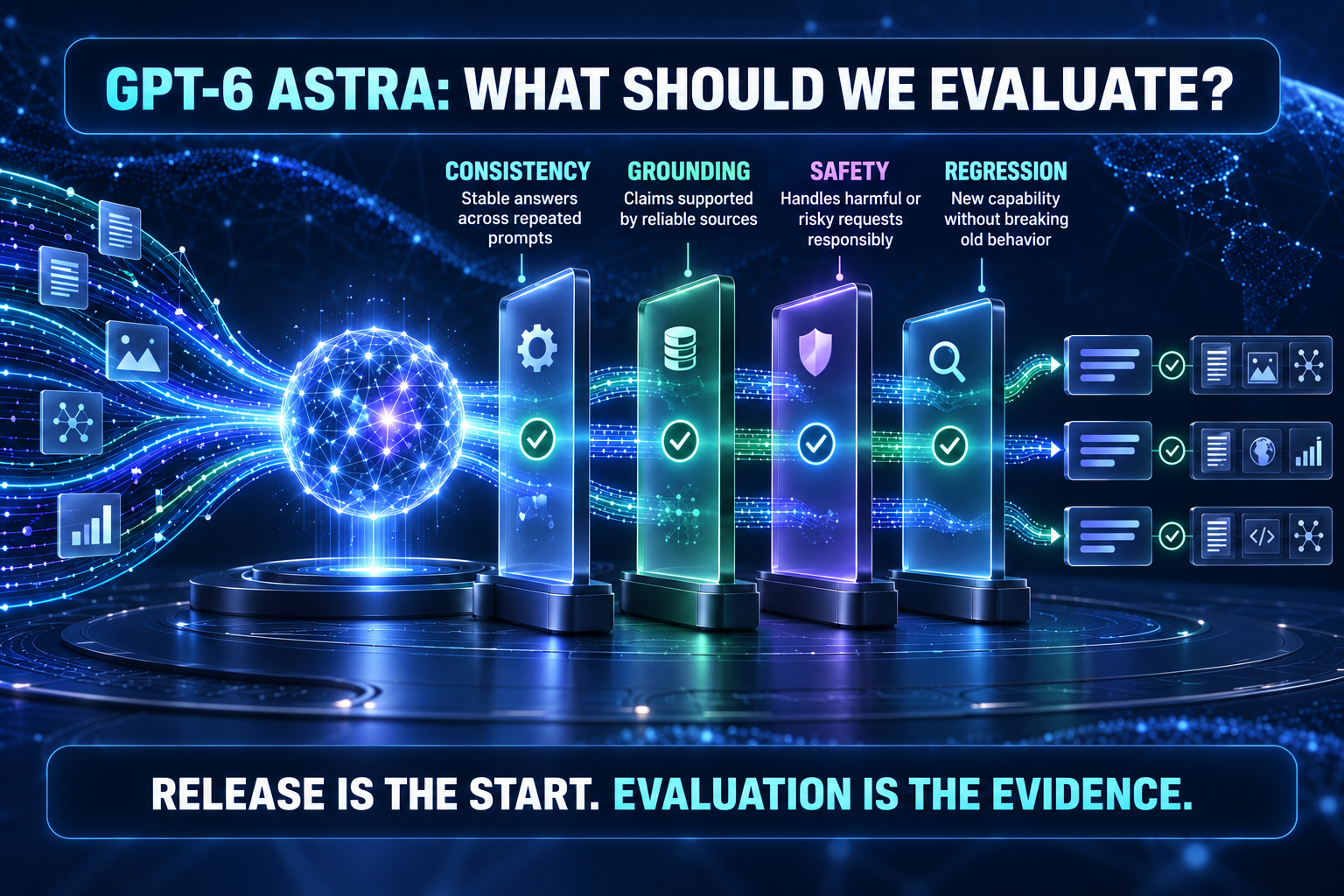
A new model release creates excitement, but capability claims are only the beginning. Quality engineering asks a second question: how reliably does the model perform in real workflows, with real users, data, tools, and constraints?
Do comparable prompts produce dependable outcomes across repeated runs and supported experiences?
How does the model handle ambiguity, source grounding, uploaded files, safety boundaries, and multi-step work?
What changes when existing prompts, evaluation rubrics, and business workflows move to the new model?
My perspective: Model upgrades should be evaluated by outcomes—not only by version names or benchmark gains. Even a more capable model needs clear acceptance criteria, repeatable regression coverage, risk-based testing, and thoughtful human review.

I’m continuing to learn how established QA practices can evolve for Generative AI—from prompt and response evaluation to repeatable regression coverage and clear quality criteria.
A brief visual summary of the evaluation questions above.
A career path connecting regulated banking, evidence-based risk thinking, software quality leadership, and the responsible evaluation of emerging AI systems.
Developed an evidence-driven, risk-aware approach through banking operations involving Anti-Money Laundering, compliance review, risk analysis, and documentation.
Built experience in software testing, requirement analysis, defect reporting, traceability, and reliable releases.
Applies a risk-aware mindset while leading quality activities for prompt-based Generative AI applications and evaluating complex user experiences.
Extending this foundation toward responsible AI through continued research, business learning, communication, and leadership development.

Master’s in Computer Science
My graduate education strengthened the technical and analytical foundation I bring to quality engineering, software testing, and my continued exploration of applied AI.

Recognized in an academic newsletter for my doctoral journey in Applied Artificial Intelligence, professional experience in quality assurance, commitment to responsible AI, and achievements beyond technology.

Technology earns trust when people can rely on what it does—and understand why.
I work with prompt-based Generative AI applications, exploring prompt behavior, evaluating responses, documenting quality risks, and helping teams deliver more dependable user experiences.
My current work is grounded in quality engineering, but my long-term professional identity is broader: Applied AI, business impact, research, and responsible technology.
I created this portfolio to share practical research notes that are useful to testers, engineers, students, leaders, and anyone curious about how AI systems can be evaluated thoughtfully.