Executive summary
A multi-agent system can divide complex work among specialized agents, but every handoff creates a new quality boundary. A reliable result depends on the correct agent receiving the correct task, only the necessary context and permissions, and a clear record of what happened when something goes wrong.
Method
Plain-English synthesis of current NIST work on interoperable and secure AI agents, official agent-orchestration and Agent2Agent documentation, and OWASP guidance on insecure inter-agent communication and cascading failures. This note proposes a practical testing framework; it does not claim original experimental results.
What the evidence suggests
A handoff can change the task
A summary may omit a constraint, alter priority, lose evidence, or turn an uncertain request into an instruction. Test the meaning transferred between agents, not only the final answer.
Access can silently expand
A specialist agent may have tools or data that the original agent did not need. Identity, purpose, tenant boundaries, and least privilege must survive every delegation.
Small errors can become workflow failures
One incorrect message can trigger duplicate work, conflicting actions, unsafe retries, or decisions based on corrupted context. Teams need containment and a clear owner for escalation.
Practical test protocol
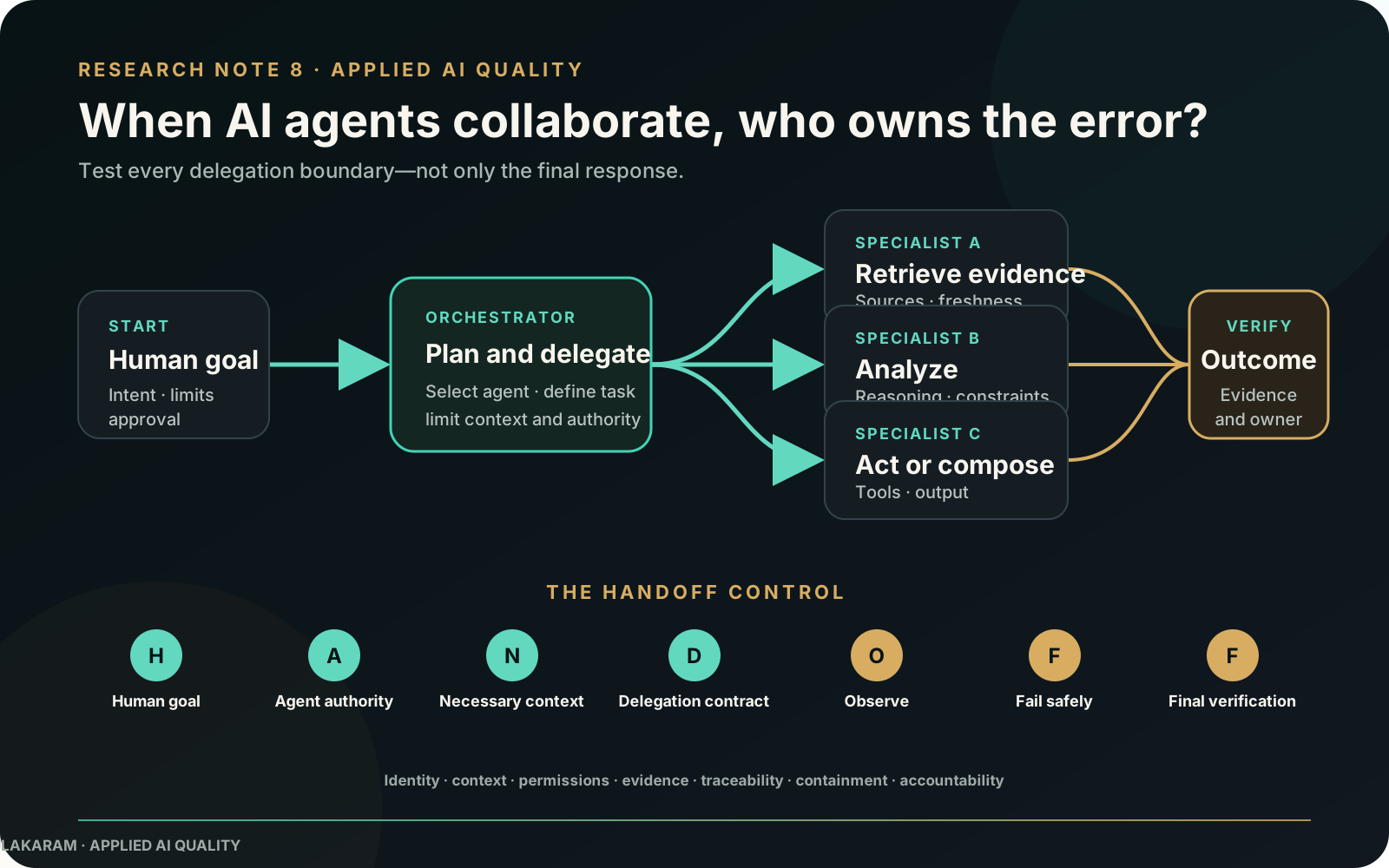
- 01Human goal: record the original request, success criteria, constraints, and actions that require human approval.
- 02Agent identity and authority: verify which agent is acting, who authorized it, which tenant it belongs to, and the minimum tools and data it may use.
- 03Necessary context only: transfer accurate, relevant, current information and exclude secrets, unrelated history, and untrusted instructions.
- 04Delegation contract: define the subtask, permitted actions, evidence required, timeout, retry rule, output format, and completion condition.
- 05Observe every handoff: connect messages, agents, tools, approvals, results, failures, and timestamps in one trace with a shared workflow ID.
- 06Fail safely: test unavailable agents, malformed messages, conflicting results, duplicate delivery, partial completion, and cascading failure; contain, retry safely, or escalate.
- 07Final verification: compare the combined result with the original goal and approved evidence before any high-impact or irreversible action.
Workflow visual
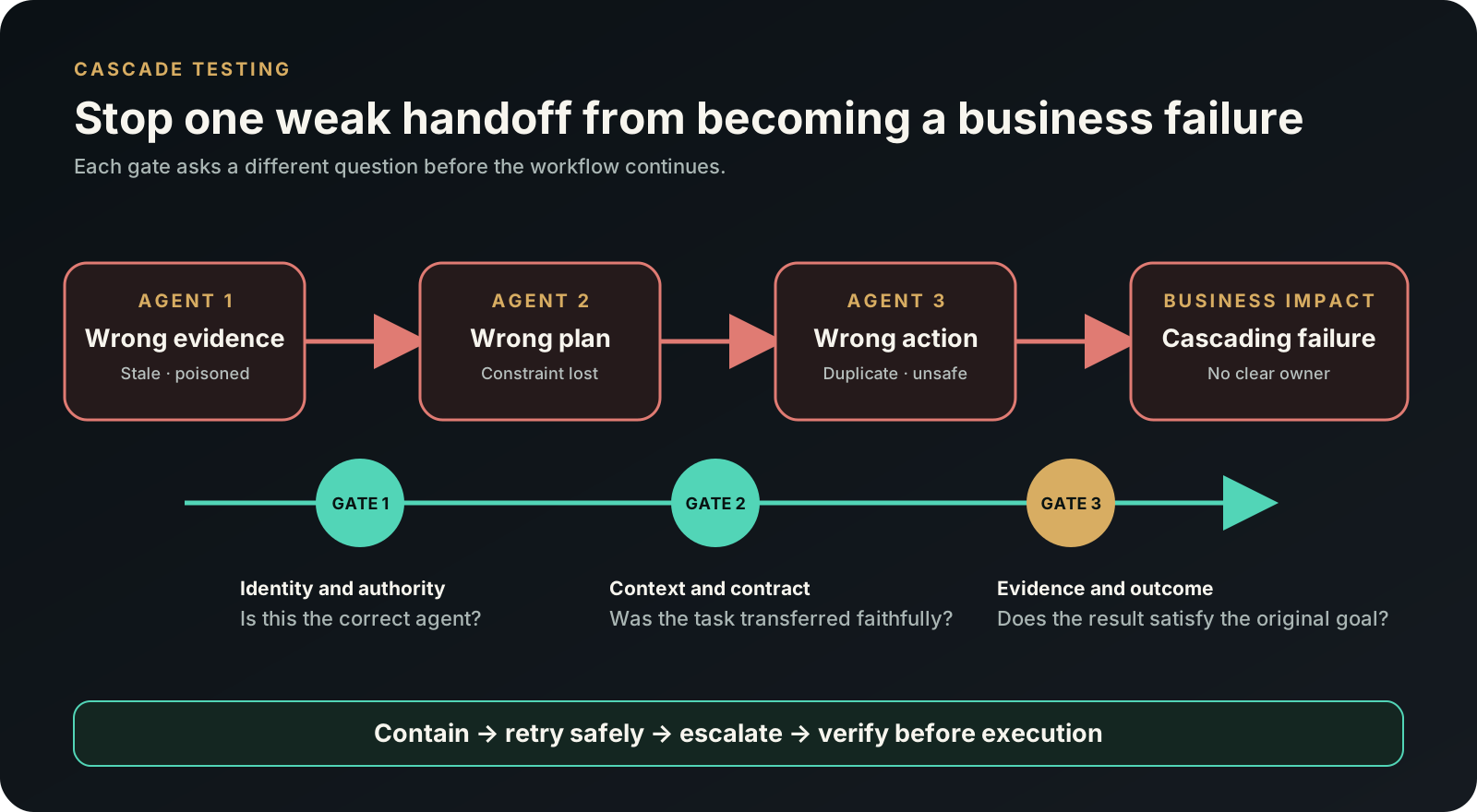
Use HANDOFF: Human goal, Agent authority, Necessary context, Delegation contract, Observe, Fail safely, and Final verification. Trust the workflow only when every handoff is testable and accountable.
Limitations
Standards and protocols improve communication, but they do not prove that an agent is correct or safe. Required controls depend on data sensitivity, autonomy, reversibility, agent ownership, and business impact. High-impact workflows still require proportionate human oversight.