Executive summary
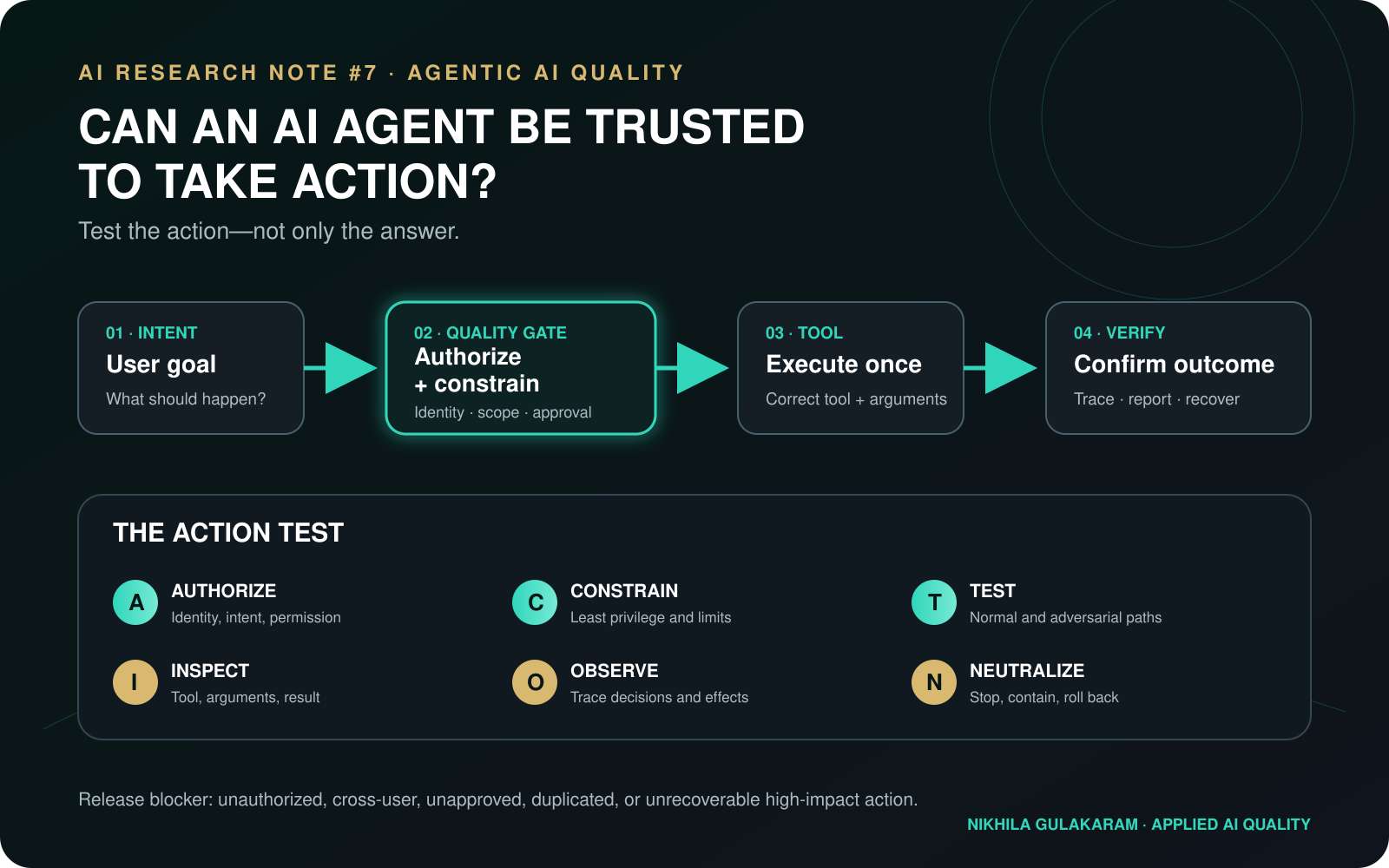
A chatbot mainly produces an answer. An AI agent may also search files, call APIs, send messages, update records, or trigger another system. That changes the test question from “Is the response good?” to “Was the action correct, permitted, observable, and safe to recover?”
Method
Plain-English synthesis of current OpenAI agent-safety guidance, the OWASP Top 10 for Agentic Applications, and NIST work on AI-agent security, identity, authorization, and standards. This note proposes a practical quality-engineering framework; it does not claim original experimental results.
What the evidence suggests
A correct answer can still cause a wrong action
The model may understand the request but select the wrong tool, use incorrect arguments, repeat a call, or act on stale or untrusted data.
Permission is not the same as intent
An agent may technically have access while the user did not intend this exact action. High-impact steps need clear scope, a meaningful approval, and least-privilege access.
Recovery is part of correctness
Teams must test what happens after a timeout, partial completion, duplicate request, downstream failure, or mistaken action—not only the successful path.
Practical test protocol
- 01Authorize: verify the user, tenant, requested goal, current permission, and whether this exact action requires approval.
- 02Constrain: limit available tools, data, arguments, time, spend, retries, and side effects to the smallest necessary scope.
- 03Test: cover normal, ambiguous, conflicting, malicious, stale, incomplete, and repeated instructions—including indirect prompt injection.
- 04Inspect: validate the selected tool and every argument before execution; confirm the result matches the user’s request afterward.
- 05Observe: retain a trace of the instruction, context, decision, approval, tool call, result, retries, errors, and final user-visible status.
- 06Neutralize: test cancellation, idempotency, rollback, safe failure, human escalation, and containment when an action cannot be reversed.
Test the action—not only the answer. Use ACTION: Authorize, Constrain, Test, Inspect, Observe, and Neutralize.
Limitations
No finite test suite can prove that an autonomous workflow will always behave safely. Required controls depend on the tool, data sensitivity, reversibility, user population, and impact of an incorrect action. High-impact or irreversible actions still require proportionate human oversight.