Executive summary
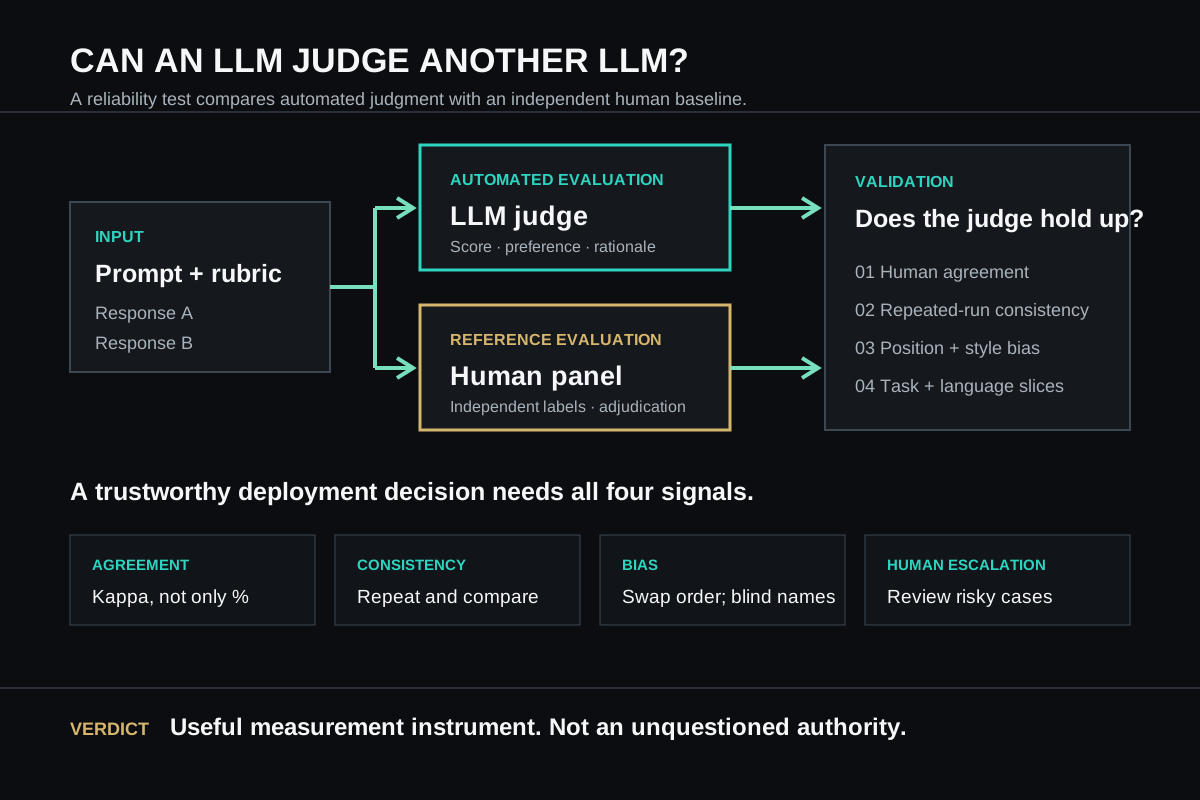
LLM judges can scale rubric-based evaluation and often align meaningfully with human preferences. Agreement, however, changes with task, rubric, language, response order, model family, and difficulty.
Method
Structured synthesis of published benchmarks and research. This note does not claim original experimental results.
What the evidence suggests
Agreement can be useful
Studies report meaningful human alignment in some open-ended comparisons, supporting use for triage and regression signals.
Consistency is not validity
A judge may repeat the same biased preference, including position, verbosity, style, or self-preference effects.
Calibration is task-specific
Performance on general preference benchmarks does not establish reliability for code, safety, health, grounded answers, or lower-resource languages.
Practical test protocol
- 01Define exactly what the judge measures.
- 02Use anchored, dimension-level rubrics.
- 03Build an independent human baseline.
- 04Blind model identity and swap answer order.
- 05Repeat representative cases and measure instability.
- 06Escalate disagreement and high-impact cases to qualified humans.
Treat an LLM judge as a calibrated measurement instrument—not an unquestioned authority.
Limitations
Reported agreement depends on benchmark design and label distributions. Model and prompt updates require revalidation.